Loading…
Permit requirements for dumpster rental are one of the most common questions we hear, and the answer usually comes down to a single factor: whether the dumpster will sit on private property or a public street.
If the dumpster fits on your driveway or another part of your private property, most municipalities don't require a permit. This covers the majority of residential rentals.
If there's no room on your property - common in dense urban areas or during a full driveway renovation - the dumpster may need to sit on the street. Most cities require a permit for this, sometimes with additional rules around reflective markers or lighting for visibility.
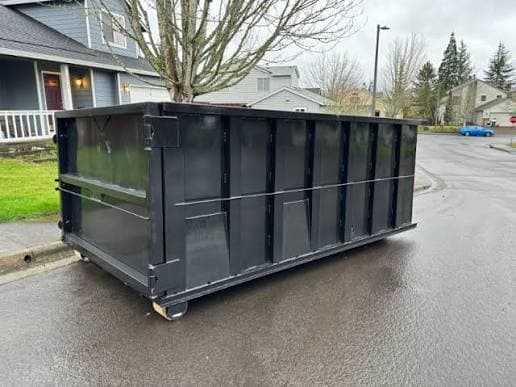
While every city sets its own rules, the permit process for street-placed dumpsters tends to follow a similar shape almost everywhere. You'll typically need the property address, the dates the dumpster will be on the street, and sometimes the dumpster's dimensions so the city can confirm it won't block a fire lane, storm drain, or designated parking. Many municipalities process these permits within a few business days, though it's worth applying at least a week ahead of your planned delivery date rather than assuming same-week approval, especially in cities that only process permit applications on certain days. Fees are usually modest and often scale with how many days the dumpster will occupy the street. Some cities cap how long a permit is valid before requiring renewal, which matters if your project timeline slips - a permit issued for two weeks won't automatically cover a project that runs a month.
A city permit only covers the public side of the equation - it says nothing about what your homeowners association allows on your own property. Many HOAs have separate rules for dumpsters, sometimes stricter than the city's: a maximum number of days a dumpster can sit in a driveway, requirements that it not be visible from the street, or a flat prohibition on placement anywhere but inside a garage during off-hours. Some HOAs require advance written notice or an approval request through the community management company, similar to how they'd handle exterior renovation approval. Skipping this step is a common surprise for homeowners who assume that because their driveway is private property, no additional approval is needed - checking your HOA's covenants, or simply asking the management company, before delivery avoids a fine or a forced early pickup that a city permit alone wouldn't have prevented.
Placing a dumpster on a public street without a required permit carries real risk beyond an abstract rule violation. Cities can issue fines directly to the property owner, and in some jurisdictions the fine is charged per day the dumpster remains unpermitted rather than as a one-time penalty - which adds up quickly on a multi-week project. Some cities also reserve the right to have an unpermitted dumpster towed or relocated at the owner's expense if it's deemed an obstruction, particularly if it blocks a fire hydrant, crosswalk, or accessible parking space. Beyond the direct cost, an unpermitted dumpster that draws a complaint can also delay your project if the city requires it removed before a permit can even be issued retroactively. None of this applies to private-property placement, which is exactly why confirming where the dumpster will actually sit is the first question worth answering, well before delivery day.
Applying for a permit too early or too late causes its own headaches. Apply too far ahead and your window may lapse before the dumpster even arrives if your project start date shifts, forcing a renewal before work has begun. Apply too late and you risk a delivery date arriving before approval comes through, leaving the dumpster stuck on private property or delayed altogether while the provider waits on paperwork. The safest approach is to apply as soon as your delivery date is firm - not before, since dates can move, and not after, since processing time varies by city. If your provider is handling the application for you, confirming they have your firm delivery date in hand, rather than an estimate, keeps the permit timeline aligned with the actual truck schedule.
Most cities publish their dumpster and roll-off permit requirements on the public works or building department section of their website, searchable with a simple search for 'dumpster permit' plus your city name. If you can't find clear information, a call to the city's public works or code enforcement office usually gets a direct answer within a few minutes. The other reliable option is your dumpster provider - established local providers deliver in the same city repeatedly and often know the permit process well enough to handle the application on your behalf as part of the rental, which is frequently the fastest path if you'd rather not research it yourself.
Renters and landlords face a slightly different permit question than owner-occupied homes. If a dumpster will sit on a rental property's driveway or private lot, the same general rule applies - private property typically doesn't need a city permit - but tenants should still get the landlord's permission before scheduling delivery, since it's not their property to authorize placement on. Multi-family properties add another layer: an apartment complex's shared lot is private property from the city's perspective, but the property management company almost always has its own approval process, similar to an HOA, covering where a dumpster can sit and how long it can stay. Skipping this step because 'it's not on the street' is a common assumption that overlooks the property management approval that's often required regardless of city permit rules.
For many projects, the simplest way to deal with permits is to avoid needing one in the first place by keeping the dumpster entirely on private property. Before delivery, walk the property and confirm there's a spot - driveway, side yard, or lot - with clear access for the delivery truck and enough clearance for the dumpster's full footprint, not just where it will sit once placed. If your driveway is short, ask your provider whether the truck can still maneuver a delivery without extending onto the street even briefly, since some cities count even temporary street presence as requiring a permit. For a driveway currently blocked by a parked vehicle or under its own repair, temporarily relocating a car elsewhere is almost always simpler and cheaper than applying for a street placement permit for what would otherwise be a private-property rental.
Once a permit is approved, keep a copy - digital or printed - somewhere easy to access during the rental, rather than only on file with the city or your provider. If a parking enforcement officer or neighbor questions the dumpster's presence on the street, having the permit on hand resolves the question immediately instead of requiring a call to city hall. It's also worth noting the exact permit expiration date somewhere visible, since a project running longer than expected is far easier to handle with a quick renewal request submitted a few days early than with a lapsed permit discovered after the fact.
Does a permit cost extra on top of the rental price? Usually yes, though some providers bundle the fee into the quote rather than billing it separately - worth asking up front. Can I apply for a permit myself instead of having the provider do it? In most cities, yes, as long as you have the required project details, though using a provider who already knows the process tends to be faster. Do permits apply to driveways with a shared or ambiguous property line? If there's any question about whether your placement spot counts as public or private property, it's worth confirming with the city directly rather than guessing, since the definition of 'public right-of-way' can extend slightly onto what feels like your property near the curb.
Because permit rules vary by city, the most reliable way to find out what's required for your address is to ask the local provider you're matched with - many handle the permit application on your behalf as part of the rental.
Occasional guides on dumpster sizing, pricing, and project planning. No spam.
Get matched with trusted local dumpster rental providers in minutes - free and with no obligation.